


What were you doing in the early 2010s. . .
Were you sitting in a Chipotle with your Chicken burrito watching flash mob videos on your brand new Ipad? Thought so.
When I wasn’t jamming to the new Lady Gaga release, I was lucky to be in the midst of the latest rage in postsecondary student success - developmental education reform. Sounds amazing, right? No joking, it was actually amazing. There was a perfect storm of research and emerging practice that was in the words of Complete College America President Stan Jones1 “A Game Changer.2”
The first critical insight that emerged was research that the structure of developmental education, not the preparation of students or the quality of the instruction were the reasons students weren’t completing gateway math and English courses. Students were generally performing well in developmental education courses, but for some reason most students never completed gateway courses. So something else was at work. Tom Bailey3 et. al. cracked the code with research showing that students were capable of learning the material, but the long remedial sequences resulted in students failing to enroll in subsequent developmental education courses and ultimately never made it to the college-level course.
This kick-ass animation below illustrates what was happening.
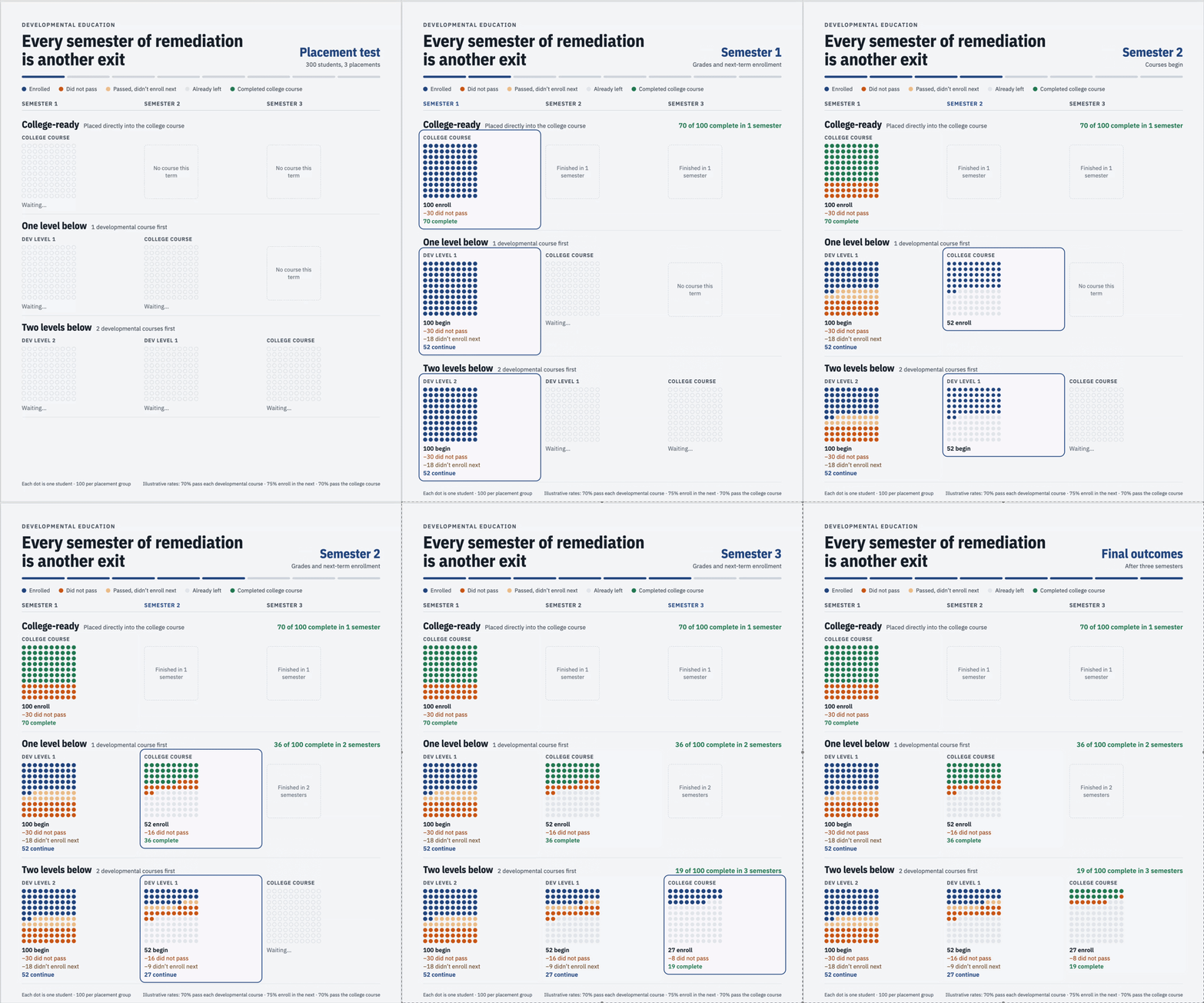
Basically, colleges with multiple semester developmental education sequences were losing around 50% of their students along the developmental education sequence each semester. The epiphany was that it was the structure of long sequences. It was not because students couldn’t learn or that teaching was ineffective. We now knew the cause of the problem, but there was no clear solution.
I had been working with the Tennessee Board of Regents at the time on ways to accelerate students through developmental education sequences using a competency based approach where students could progress through sequences at their own pace, allowing some to plow through their sequences in as little as a semester. The results were, ok. We did see some students get through sequences faster, but nothing earth shattering. But, there was this one project at Austin Peay State University that did something different. A proper English gentlemen with a PhD from Cambridge, named Tristan Denley (maybe you have heard of him) eliminated developmental education courses altogether on campus and enrolled students in what we now call a corequisite course that students took alongside the college-level course. The results were immediate, dramatically more students were passing their gateway math and English courses. At the same time, there was an English faculty member that came right out of central casting for an English professor (gray beard, tweed coat, and professorly manner) at the Community College of Baltimore named Peter Adams who was doing something very similar. He had also developed a corequisite model for English called the Accelerated Learning Program (ALP) and he was also getting remarkable results.
These reforms captured the imagination of Stan Jones at CCA and he made it the agenda of CCA to promote the reforms Peter and Tristan had implemented.
CCA was aggressive in its advocacy for reform as evidenced by the release of a report with the provocative title called “Remediation: Higher Education’s Bridge to Nowhere.”4 It raised the eyebrows of many and generated a great deal of blow back from the field.5 It was a bold statement that you rarely see in higher education, but it catalyzed action.
Many did not believe that corequisites could work for all students, particularly for students who were assessed at the lowest levels, but CCA stuck to its guns by arguing that prerequisite developmental education needed to be eliminated.6
Here is a video from one of our many roadshows at the time where Tristan, Peter, and Stan make the case for the elimination of prerequisites and the scale of corequisites.
The battle was intense, but over time the evidence got stronger and stronger that corequisites were superior to prerequisite developmental education. In fact, the evidence was so strong that Education Commission of the States, Jobs for the Future, The Charles Dana Center, and Complete College America came together and published a joint statement entitled: Core Principles for Transforming Remedial Education. The statement shared the powerful evidence in favor of reform and created a blueprint for how states, systems, and institutions should go about reforming developmental education.
As the 2010s progressed, the Connecticut legislature passed a law requiring the use of corequisites for most students, the Tennessee Board of Regents instituted a policy to eliminate prerequisite developmental education and scale corequisites, and University of System of Georgia did the same.
Eventually Texas and California passed legislation that largely eliminated prerequisite remediation and implemented corequisites. At that point, I thought we had achieved a tipping point. A red state and and blue state had decided to scale corequisites. I didn’t think there was anything that would stop the reforms from reaching all 50 states. Well, I was wrong. (This is why I won’t ever trade on Kalshi).
The work was on going, through efforts at Strong Start to Finish, but the rate of change began to slow. Guided Pathways emerged as the reform of the day. It was a tremendous innovation, but it deprioritized developmental education reform in favor of a more comprehensive approach to student success. Guided Pathways captured the imagination of the reform community and developmental education reform took a back seat.
Developmental education reform is the one reform that has generated the greatest improvements in student success at scale. The shift from prerequisites to corequisites routinely results in gateway success rates that are double, triple or even quadrupled over what they were pre-reform. Now there is evidence that without developmental education reform, you are unlikely to see dramatic improvements from other reforms like Guided Pathways. Too many students are still getting placed into ineffective prerequisite developmental education courses - particularly in math - and that is not ok. It is critical to pursue these reforms so that all students can benefit. Here are just a few examples of the results that have been achieved at scale across the country.
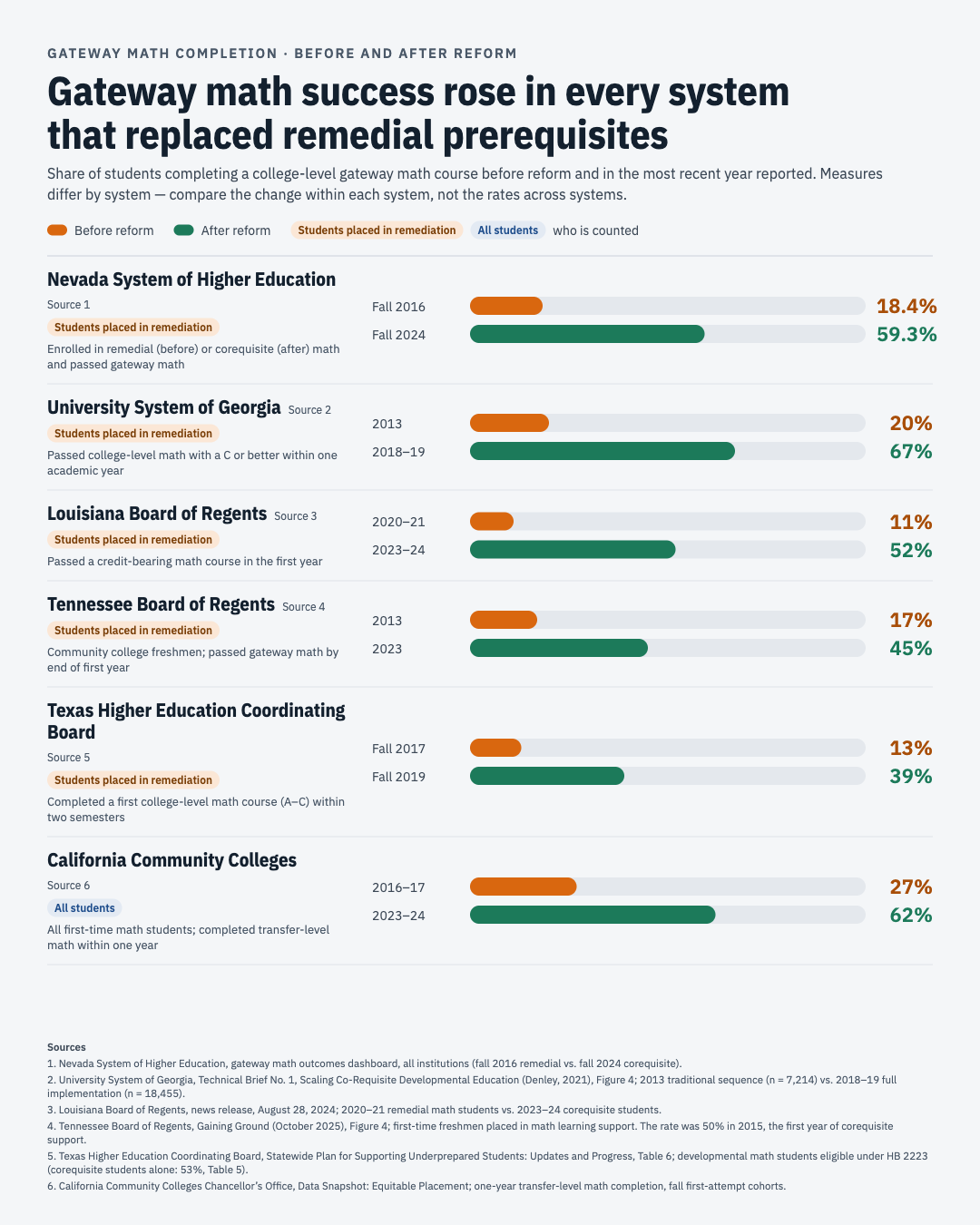
The developmental education reform movement is not over, but it is moving at a slower pace. Additional systems and states have adopted the reforms but only a couple of states have fully scaled the full suite of developmental education reforms for all students at both 2-year and 4-year institutions.
So let’s all pretend it is 2012 again. Pull up Adele 21 on your streaming service, slip on those skinny jeans, and get to work.
What do you think about this post? Why haven’t we gotten to the finish line on developmental education? What needs to be done to move the needle on developmental education reform. Join the conversation.
We are coming up on the ten year anniversary of Stan’s passing. He was my greatest mentor and his work was and remains an inspiration. Stan was not everyone’s cup of tea, but his views were always informed by the hundreds of conversations he had with researchers and practitioners in the field. If you don’t know Stan, take a minute to google him. It will be worth your time.
I think Stan Jones’ talks on the Game Changers were brilliant. They appealed to all audiences, practitioners and policymakers alike. Here is a link to a video if you want to dig deeper.
Full disclosure, there are a lot of old white dudes in this piece. There are dozens of amazing women and people of color who contributed to and our powerful leaders in the developmental education movement. You will learn about many of those leaders here in Momentum Makers. I am fully committed to telling their stories.
Side note, two years before Bridge to Nowhere I wrote a report at ECS called Rebuilding the Remedial Education Bridge to College Success. Coincidence? Maybe. BTW my report is terrible and thankfully it is very hard to find online. Don’t look for it, I’m begging you.
I encountered many furious people at the time. I made many presentations in front of people who were openly hostile. Many, if not most people I encountered, once they witnessed the evidence were able to change their minds and recognize the effectiveness of these reforms. These are the people I have the greatest respect for, professionals who push back on a new idea, but allow themselves to be persuaded by the research, even if it is contrary to their own experience.
To be fair, this remains one of the biggest issues for developmental education reform. Finding solutions for students assessed at the lowest levels. But there is no evidence that putting them into prerequisite developmental education would be any better. I will have more to say about this down the road.