



Photo by Allison Shelley/Complete College Photo Library
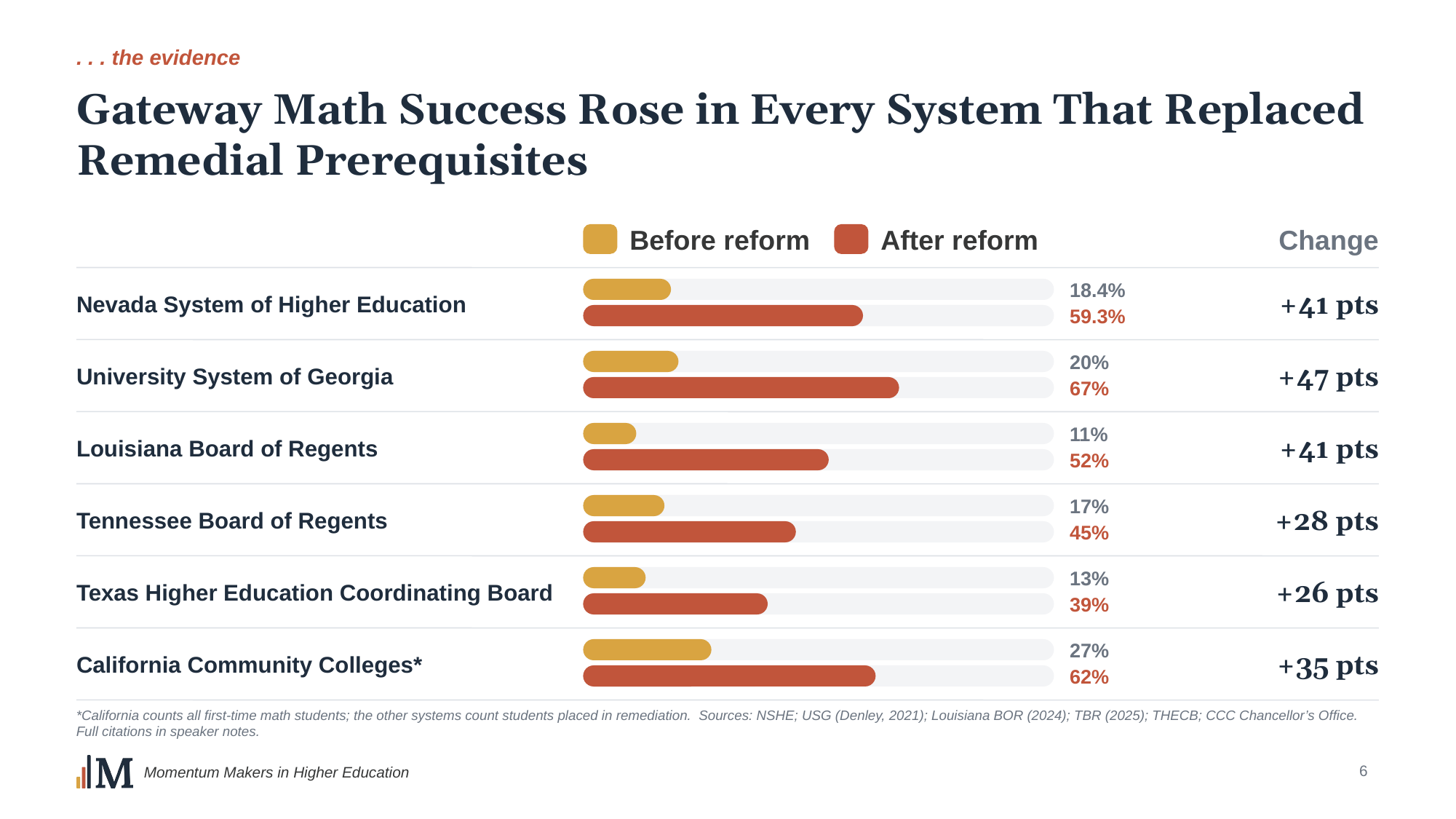
Season One of the Momentum Makers in Higher Education Podcast is dedicated to developmental education reform. You might be asking, why developmental education reform? Personally, the scaled implementation of effective developmental education reforms has been my white whale. More importantly, it is the single reform that I have seen in my 30+ years in student success work that has been truly transformational. The evidence of its effectiveness at scale can not be overstated. Rigorous studies and state-level data demonstrate that eliminating prerequisite developmental education, replacing prerequisites with corequisite support, designing general education math courses aligned to programs of study, and using High School GPA to place students has proven to increase the number and percent of students who complete gateway math and English in their first year.
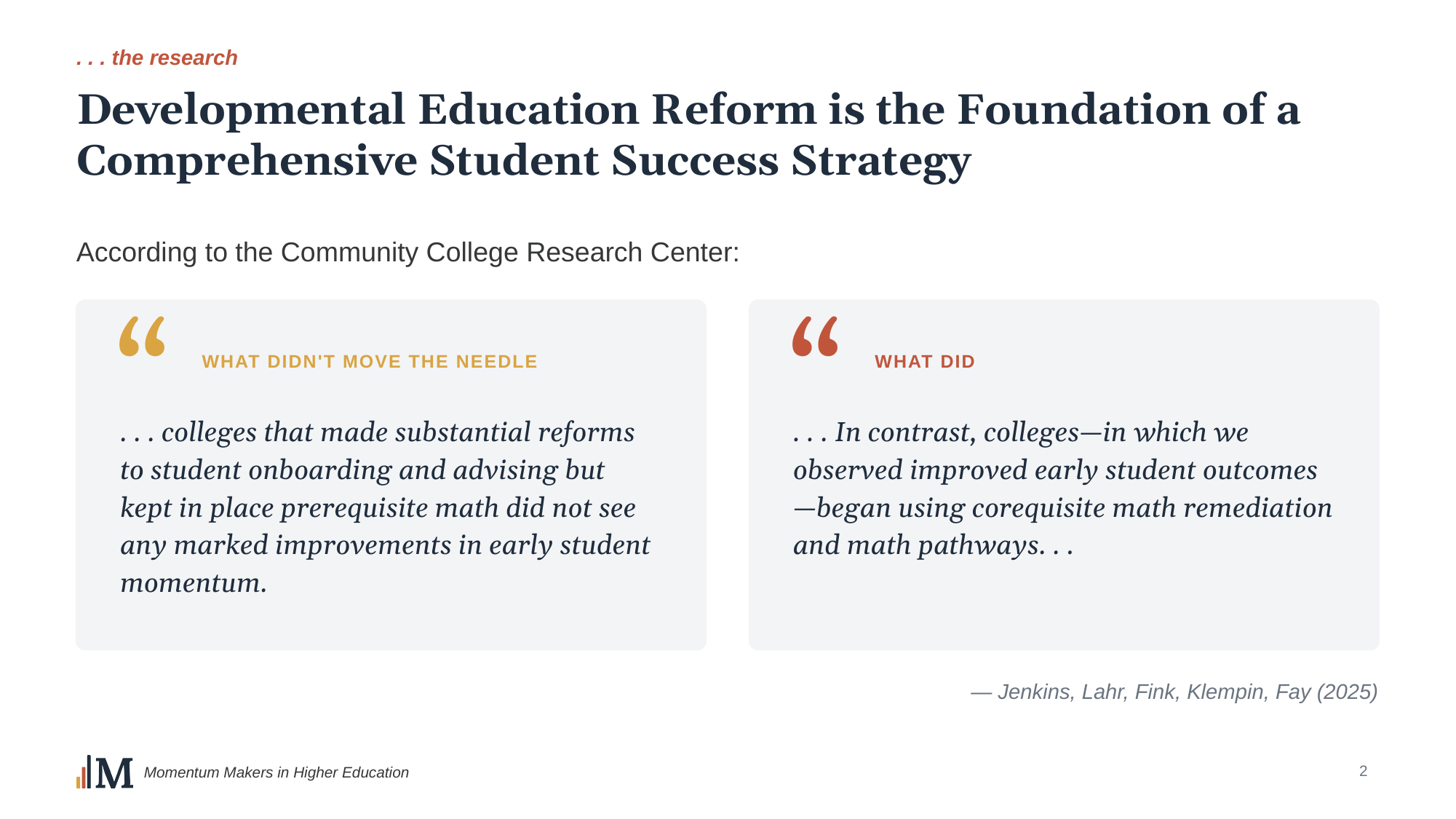
If the data on its effectiveness with gateway course success is not enough, we now have data from the Community College Research Center in their new book entitled, More Essential Than Ever1, that comprehensive student success strategies, such as Guided Pathways, are less likely to show improvements in student outcomes they have not reformed developmental education.
Despite over ten years of data demonstrating the effectiveness of developmental education reform, too few states, systems, and institutions have fully scaled reforms.
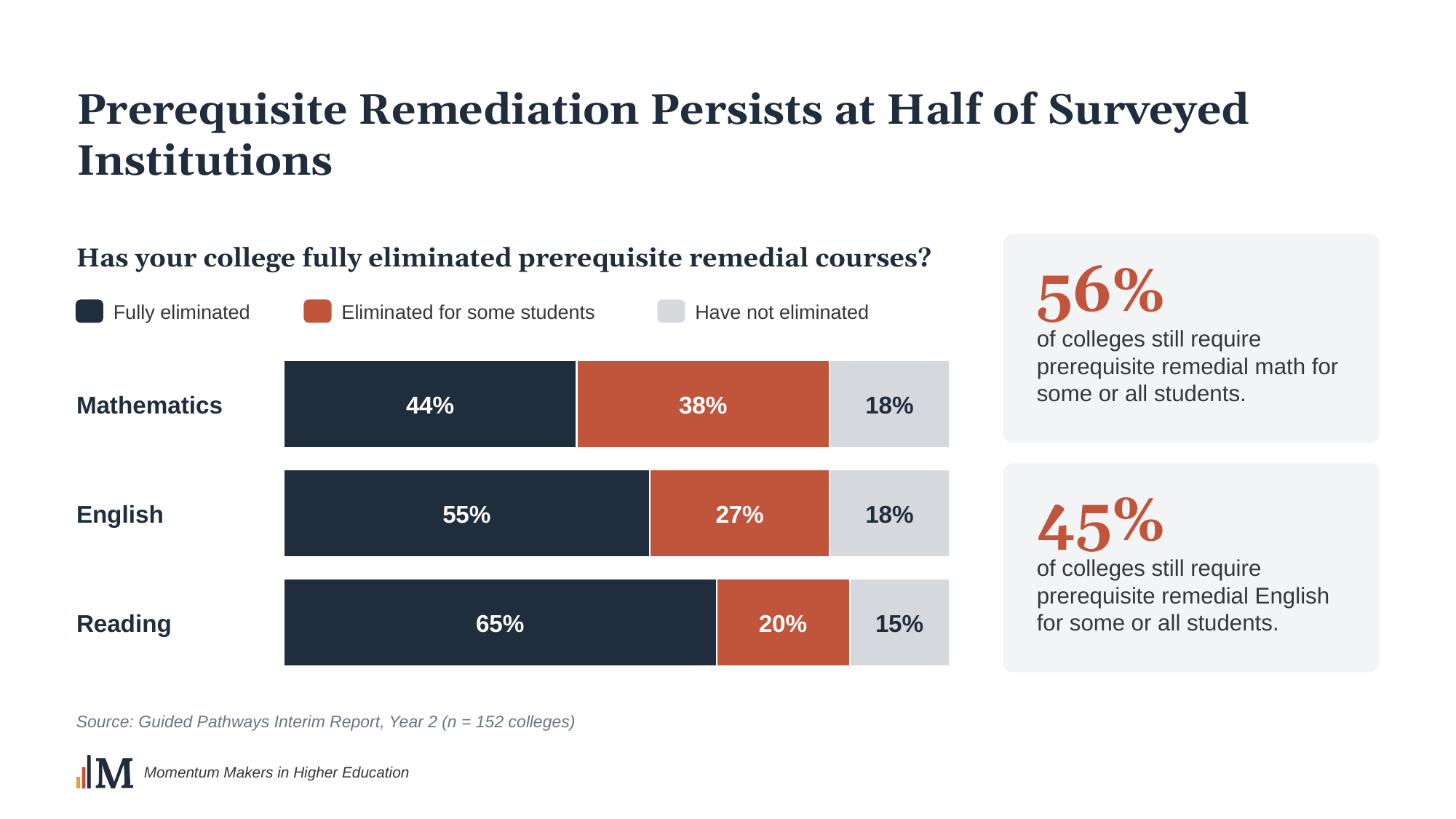
For example, many institutions that have participated in state or national Guided Pathways initiatives to implement comprehensive student success reforms have not eliminated prerequisite remedial education courses. Bruce Vandal Consulting (That’s me) and WestEd have been researching the implementation of both developmental education and Guided Pathways reforms. The Guided Pathways research examined the fidelity of implementation of Guided Pathways strategies at institutions that have been identified as “Guided Pathways institutions”.2
We surveyed institutions and AI supported web scans of institutions. Of those surveyed, only about half have fully eliminated prerequisite developmental education.
The web scan of over 300 institutions found that only 50% showed evidence of implementing corequisites in math or English. We also know that many institutions have implemented corequisites, but have not scaled it for all students.
Why is having corequisites for all students important? First, the evidence is clear that all students, regardless of their placement are better off in corequisites.3 We also have new research from Wonsun Ryu, Yujin Kwon, and Lauren Shudde that those students who enroll in gateway math and English in their first year are more likely to achieve academic momentum toward a credential.4 The study examined the impact of California’s landmark legislation AB 705 on access to transferable math and English courses and the impact of access on academic momentum for California community college students. They found that simply enrolling in a gateway math and English course in the first year is corrleated to longer term student outcomes. However, they also found that uneven implementation of reforms across institutions meant that the benefits of the reform did not reach all students.
This brings me to the second reason to scale developmental education reforms for all students. Stopping short of scaling corequisites for all students exacerbates existing inequities in student outcomes. When an evidence-based strategy is available to some but not all students, students from underserved communities are more likely to be denied access to the reform. In California community colleges, institutions that serve high populations of low-income students and BIPOC students were less likely to expand access to transferable courses by offering corequisite support. As a result, the initial implementation of the reform actually exacerbated inequities across institutions.
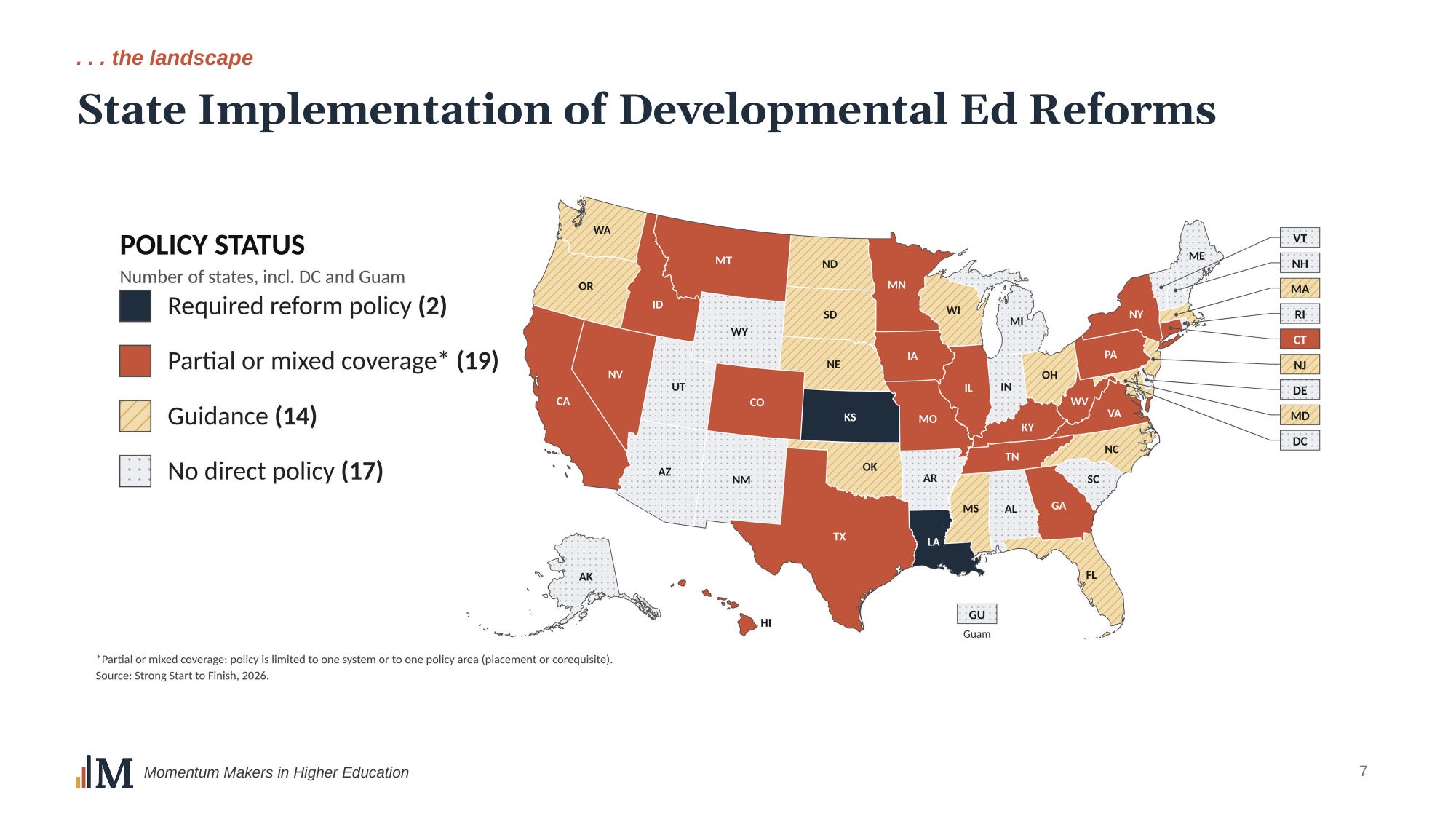
California has addressed this issue to some degree through the adoption of AB 1705, but there are other states that have implemented developmental education reforms, but have not scaled it for all students. In an analysis done by Strong Start to Finish, only two states have implemented developmental education reforms for all students.
In my work with states and systems on developmental education reforms I have seen the following reasons states have not fully scaled reforms. They include:
One postsecondary system has implemented reforms, but other systems have not.
State policy merely recommends the implementation of reforms, but does not mandate it.
State policy allows institutions to continue prerequisite developmental education for a segment of students.
State or system policy allows colleges to refer admitted students with high school equivalencies to adult basic education,
Colleges offer summer bootcamps or adaptive courseware that students are either encouraged or required to complete before accessing gateway math and English courses.
No mechanisms are incorporated into the policy to hold institutions accountable for implementation of reforms.
Policy language has been vague, resulting in institutions implementing reforms that are not consistent with evidence-based practices.
In fact, the California research found that providing institutions too much flexibility in implementation resulted in the uneven implementation of reforms and widening inequities. Ryu, Kwon, and Schudde question whether providing wide discretion to institutions when implementing a proven reform might undermine the effectiveness of the reform, particularly for underserved students.
BVC and WestEd examined state and system developmental education policies in its research for the Gates Foundation and developed definitions of strong and weak developmental education reform policy.
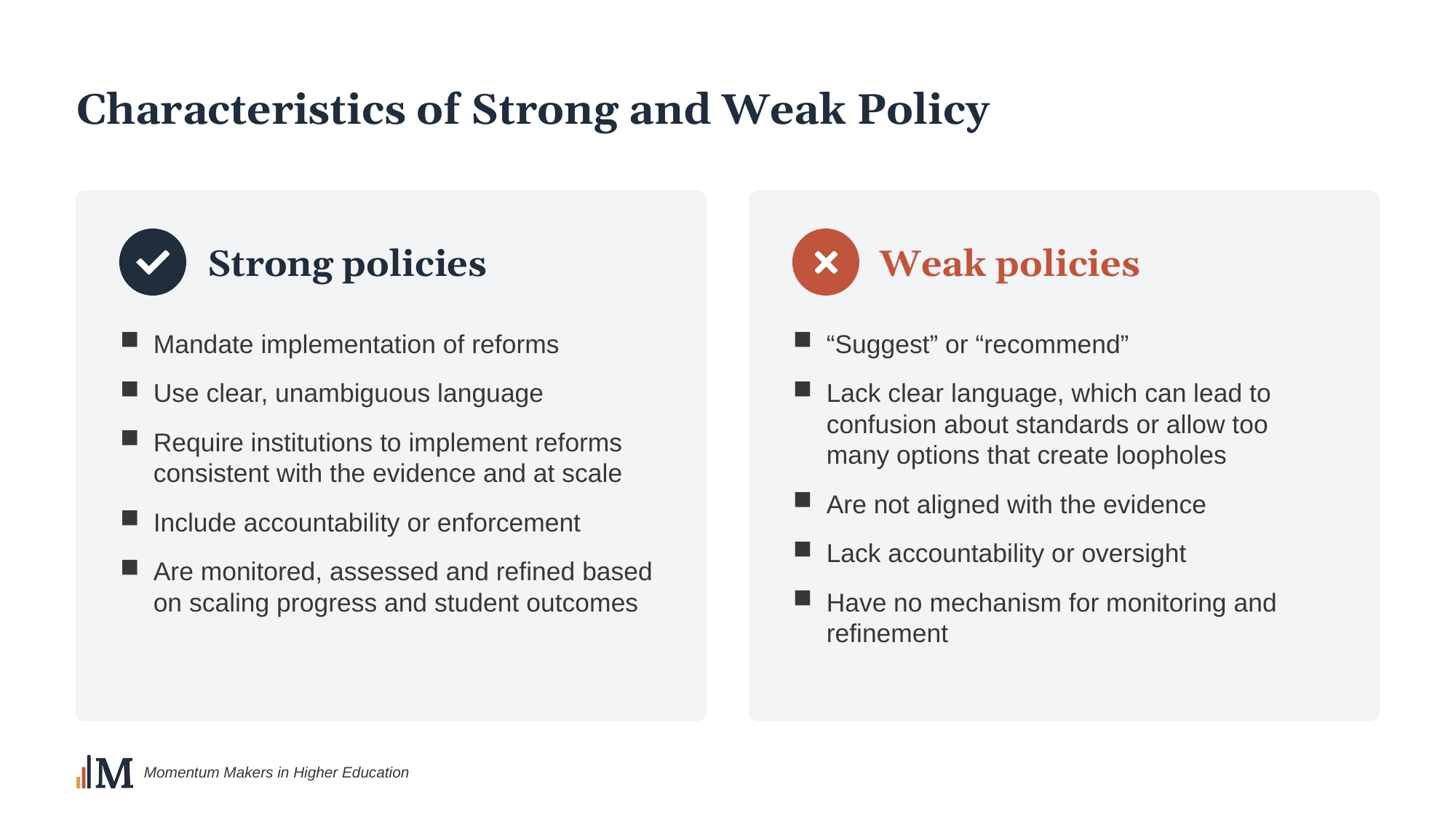
When we released these definitions, some pushed back that the definitions are too restrictive and undermind innovation. That may be the case, but we also know that policies that meet the strong policy definition have resulted in scaled reforms in several states and systems.
Having said that, we do want to encourage innovation. We want reforms implemented with fidelity, but we don’t want to choke off innovation. In fact, research done by PhaseTwo Advisory5 found that when institutions implemented placement reforms to comply with policy, less innovation occurred. A second recently released report on innovation in developmental education reform continues to examine the benefits of and barriers to innovation, particularly when it comes to improving upon the success rates in corequisites.
Ryu, Kwon, and Schudde agree that strong policy is necessary, but that institutional discretion is also important. They suggest that states and systems use “bounded institutional discretion” in policy development and implementation. Essentially, it is the balance between the clarity of policy to ensure fidelity of implementation is consistent with the evidence, but with enough flexibility to empower institutions to experiment with other solutions to further improve student outcomes.
The challenge for the field is how do design policy in a manner that provides discretion to institutions to implement the reforms to fit their context and to allow for innovation without the risk of undermining results, particularly for underserved students.
During Season 1 of Momentum Makers in Higher Education, we will examine the tension between the implementation of evidence-based reforms with fidelity and the need to provide freedom to institutions to innovate.
In Episode 1, I spoke with leaders from the Tennessee Board of Regents. TBR has struck a balance between fidelity of implementation and the flexibility to innovate. We discuss, at length about the necessity to innovate and how state systems can catalyze experimentation on campuses. In future podcasts, we will speak with leaders from the Louisiana Board of Regents and the Kansas Board of Regents on how they have developed strong policy and catalyzed innovation to address ongoing challenges and to further improve outcomes for students.
The Momentum Makers in Higher Education Podcast drops every Thursday and is available on Spotify, YouTube, Apple Podcasts, and other podcast platforms.
Jenkins, D.; Lahr, H.; Fink, J.;Klempin, S.; Fay, M. (2025) More Essential Than Ever: Community College Pathways to Educational Success and Career Success. Harvard Educational Press.
Guided Pathways institutions were institutions that participated in national or state-level Guided Pathways initiatives, often funded by the Gates Foundation. It also includes institutions that may not have been part of an initiative, but have self-identified as a Guided Pathway institution and/or are implementing reforms consistent with the Guided Pathways framework.
Ran, Florence Xiaotao, and Hojung Lee. (2024). Does Corequisite Remediation Work for Everyone? An Exploration of Heterogeneous Effects and Mechanisms. (EdWorkingPaper: 24-928). Retrieved from Annenberg Institute at Brown University: https://doi.org/10.26300/h26j-2484
Ryu, W., Kwon, Y, & Schudde, L. (September, 2026). Developmental education reform and student outcomes at California Community Colleges: The role of transfer-level course enrollment. AERA Open. https://repositories.lib.utexas.edu/items/02c7a5ac-9919-4f92-aef3-143adbc4e3b1
Karp, M. M. & Lyons, S. M. (2024). Placement-as-Transformation: A national exploration of placement and its role in building more equitable broad-access colleges. Phase Two Advisory.